WELCOME TO
THE ATLANTIC CURRENT
Welcome to The Atlantic Current – your go-to source for smart AV tips, behind-the-scenes insight, industry news, and inspiration. Whether you're planning your next project or just curious about the latest in AV tech, we’ve got you covered.
Stay in the know — sign up for our newsletter and catch the Current as it flows!
10/12/26
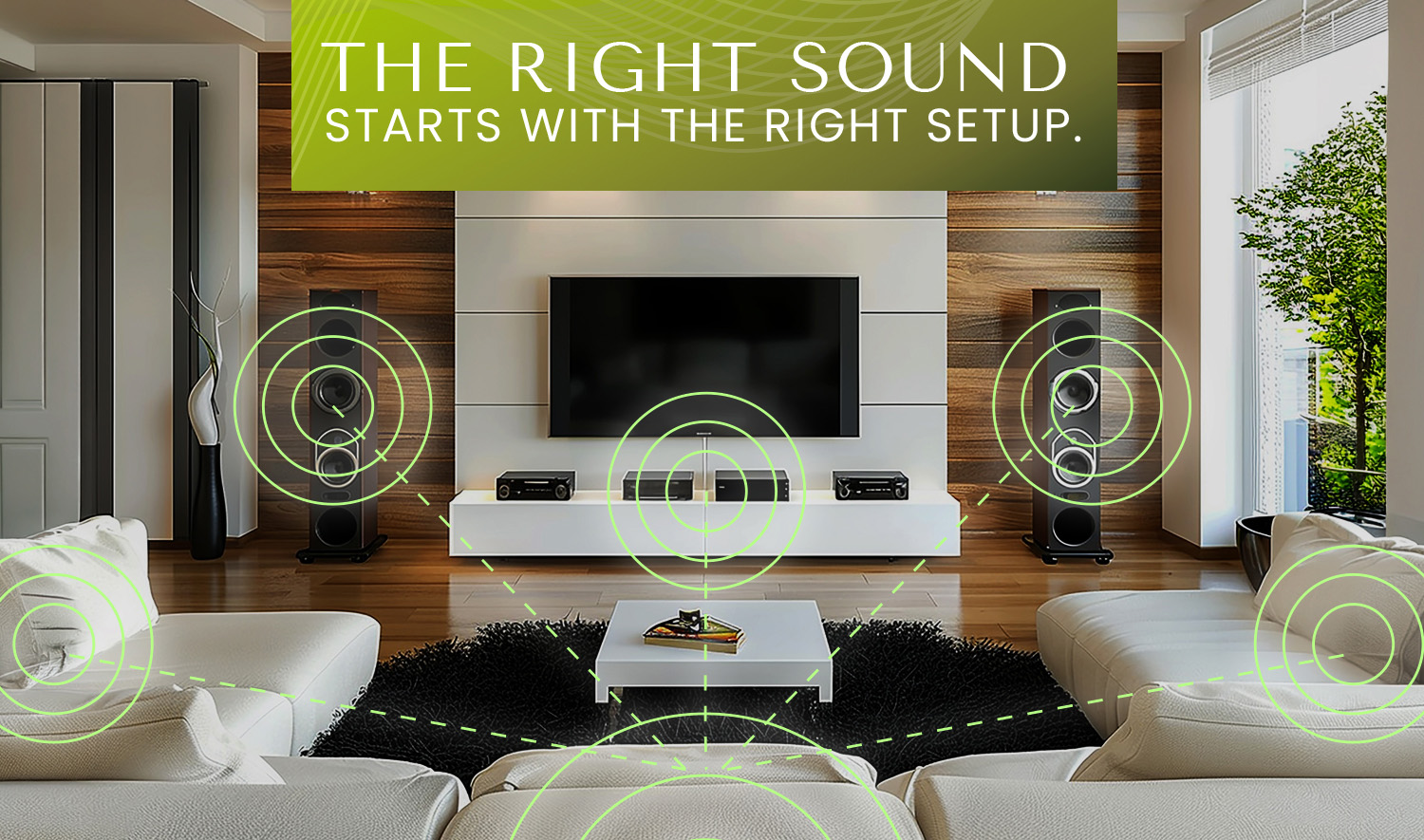
SOMETIMES THE BIGGEST IMPROVEMENT TO YOUR SYSTEM DOESN’T INVOLVE REPLACING ANYTHING.
When someone asks me how they can make their audio system sound better, the conversation usually starts with equipment.
Do I need better speakers? A bigger amplifier? A new processor? A better subwoofer?
Sometimes the answer is yes. But after more than two decades in this industry, I’ve learned that one of the biggest improvements you can make to an audio system doesn’t always involve replacing anything.
Sometimes, the best upgrade is simply getting the system you already own properly positioned, set up, and calibrated.
You can put together an incredible collection of equipment, but the room ultimately has a tremendous influence on what you hear. Speaker placement, listening position, reflections, bass response, crossover points, levels, timing, and how the subwoofers interact with the main speakers all play a role in the final result.
And no two rooms are exactly alike.
That’s why simply taking great equipment out of the box, putting the speakers where they happen to fit, and connecting everything doesn’t mean you’re hearing anywhere near what that system is capable of delivering.
SPEAKER PLACEMENT CAN COMPLETELY TRANSFORM A SYSTEM
BEFORE WE CALIBRATE THE ELECTRONICS, WE NEED TO GET THE PHYSICAL SETUP RIGHT.
Before we even start talking about electronic calibration, there is something even more fundamental: where the speakers are physically located in the room.
Proper speaker placement is part science, part experience, and part critical listening. Someone who understands the physics behind how a loudspeaker interacts with a room can sometimes make a dramatic change in the performance of a system without changing a single component.
Moving a speaker a matter of inches can change what you hear.
That may sound like an exaggeration until you’ve experienced it.
A loudspeaker isn’t operating independently of the room around it. As soon as that speaker begins producing sound, that energy starts interacting with the floor, ceiling, front wall, side walls, furniture, and every other surface in the space. Some frequencies are reinforced. Others can partially cancel. Reflections arrive at your ears slightly after the direct sound from the speaker and can affect imaging, clarity, and tonal balance.
This becomes especially noticeable in the bass frequencies.
The distance between a speaker and the walls around it can dramatically affect bass response. Put a speaker too close to a boundary and certain frequencies may become exaggerated and muddy. Move it to another location and you can create cancellations that make it seem like the speaker has very little bass at all.
The interesting part is that neither problem necessarily has anything to do with the quality of the speaker.
It’s physics.
That’s why someone who understands speaker placement doesn’t simply measure the room and put the speakers an equal distance from each wall. We’re considering how the speaker loads the room, where the listening position is located in relation to the room’s dimensions, how reflections are reaching the listener, and how the left and right speakers interact with both the room and each other.
THEN THERE IS TOE-IN—THE ANGLE OF THE SPEAKERS TOWARD THE LISTENING POSITION.
Changing that angle can affect imaging, soundstage width, high-frequency balance, and how precisely instruments and vocals appear between the speakers. Depending on the design of the speaker and the room, a relatively small adjustment can take a vocal that seems vaguely located somewhere between the speakers and suddenly lock it directly into the center of the soundstage.
When it’s right, you shouldn’t hear two speakers.
You should hear a performance.
On a great recording, the speakers can almost disappear. The vocalist may appear directly in front of you, while individual instruments occupy their own positions across a soundstage that can extend beyond the physical locations of the speakers. You begin to hear depth as well—some performers seem closer while others appear farther back.
That’s one of those moments where high-performance audio becomes really special.
And you can’t buy your way out of poor placement.
You could replace a very good pair of speakers with a substantially more expensive pair, but if they’re placed incorrectly in the same problematic locations, you may still never hear what the new speakers are capable of.
That’s why physical setup should come before electronic correction whenever possible.
THE LISTENING POSITION MATTERS TOO
WE’RE NOT ONLY POSITIONING THE SPEAKERS. WE’RE POSITIONING THE LISTENER.
You can spend an enormous amount of time getting speakers positioned correctly and then put the primary listening position in an acoustically poor location in the room.
This is particularly important with bass.
Low frequencies create standing-wave patterns within a room, which means different locations can experience dramatically different bass response. Move from one seat to another and a particular bass note can go from overwhelming to almost disappearing.
If the primary seat happens to be sitting in a significant null, simply turning up the subwoofer isn’t necessarily going to fix the problem. You may just make that frequency excessively loud everywhere else in the room while it remains weak at the listening position.
Sometimes moving the listening position slightly can produce a greater improvement than adding more equipment.
This is why good system design considers the relationship between the room, the speakers, and the listener as one complete system.
THE ROOM IS PART OF THE AUDIO SYSTEM
THE SAME EQUIPMENT CAN SOUND COMPLETELY DIFFERENT IN TWO DIFFERENT ROOMS.
We can install the exact same speakers and electronics in two different rooms and end up with two very different results.
One room may naturally reinforce certain frequencies while reducing others. Large windows and hard surfaces may create reflections. An open floor plan may behave completely differently than an enclosed dedicated listening room.
That’s where calibration becomes incredibly powerful.
Today’s better processors and receivers have remarkably sophisticated room-correction technology available. Systems can measure what’s actually happening at the listening position and allow us to compensate for certain problems within the room.
But there’s an important distinction here:
Room correction shouldn’t be used as a substitute for proper system design and speaker placement.
If we can solve a problem physically before trying to solve it electronically, that’s usually where we want to start.
We first want the speakers, subwoofers, and listening position working with the room as well as they reasonably can. Then we can use calibration to refine the result.
That’s a very different philosophy from simply putting the equipment wherever it’s convenient, running an automatic calibration program, and assuming the computer will fix everything.
CALIBRATION IS MORE THAN PUSHING A BUTTON
THE SOFTWARE IS POWERFUL. KNOWING WHAT TO DO WITH THE INFORMATION IS WHERE EXPERIENCE MATTERS.
Modern room-correction systems are incredibly powerful, but the software is only part of the equation.
Knowing how to interpret those measurements matters.
We look at crossover points, speaker levels, distance and timing, subwoofer integration, frequency response, and how the system behaves throughout the listening area. In more advanced systems, we’re looking at how multiple subwoofers interact with each other and with the main speakers.
And sometimes knowing what not to correct is just as important as knowing what to correct.
The goal isn’t to make a graph on a computer screen look perfect.
The goal is to make the system sound right.
Measurements give us information. Experience and critical listening tell us what to do with that information.
SOMETIMES YOU ALREADY OWN THE UPGRADE
PROPER PLACEMENT AND CALIBRATION CAN REVEAL PERFORMANCE YOU DIDN’T KNOW WAS ALREADY THERE.
We’ve had situations where proper placement and calibration have made such a substantial improvement that you would swear a piece of equipment had been replaced.
Bass that previously sounded heavy or disconnected becomes tight and controlled. Dialogue becomes clearer. Imaging becomes more precise. A subwoofer that seemed underwhelming suddenly integrates with the main speakers instead of sounding like a separate box sitting somewhere in the room.
In a properly set up two-channel system, you can close your eyes and almost forget the speakers are there.
For home theater, the same concept applies. You shouldn’t constantly be thinking about which speaker a sound is coming from. The speakers should work together to create one convincing environment around you.
That’s what we’re trying to achieve.
BETTER EQUIPMENT STILL MATTERS
GREAT EQUIPMENT DESERVES A GREAT SETUP.
None of this is to suggest that equipment doesn’t matter. It absolutely does.
There are very real differences between speakers, amplifiers, processors, DACs, subwoofers, and source components. We spend a tremendous amount of time evaluating products and determining which ones we believe deliver the best performance and reliability.
But great equipment deserves a great setup.
I’ve always believed that selling someone an expensive audio system and not taking the time to properly position, configure, and calibrate it is leaving the job unfinished.
It’s a little like buying a great guitar and never having it properly set up. Everything may technically work, but you’re not experiencing what the instrument is actually capable of.
BEFORE YOU REPLACE IT, LISTEN TO WHAT YOU ALREADY HAVE
THE RIGHT SOLUTION ISN’T ALWAYS A NEW COMPONENT. SOMETIMES IT’S UNDERSTANDING WHAT’S HOLDING YOUR CURRENT SYSTEM BACK.
This is why, when someone tells me they’re unhappy with the sound of their system, I don’t automatically assume they need new equipment.
First, I want to know why.
Maybe something truly is the weak link and needs to be upgraded.
But maybe the speakers are six inches away from where they really want to be.
Maybe the listening position is sitting in a bass null.
Maybe the speakers need a different amount of toe-in.
Maybe the subwoofer isn’t properly integrated.
Maybe the crossover settings aren’t right.
Maybe room correction was never performed—or wasn’t performed correctly.
Those are very different problems, and they require very different solutions.
One of the things I’ve always enjoyed most about high-performance audio is chasing that last level of performance. Sometimes that means an exciting new pair of speakers, amplifier, processor, or another new piece of equipment.
But sometimes the component that makes the biggest difference isn’t a component at all.
It’s having someone who understands the physics of sound take the time to properly position the system, measure what is actually happening in the room, critically listen to the results, and then bring all of those pieces together.
Before you start replacing equipment, make sure you’ve actually heard what your current system is capable of.
You might already own your next audio upgrade.
— Ryan Thurston
Founder, Atlantic AV